Darwin's Most Quoted Sentence Is Not His: 30 That Are
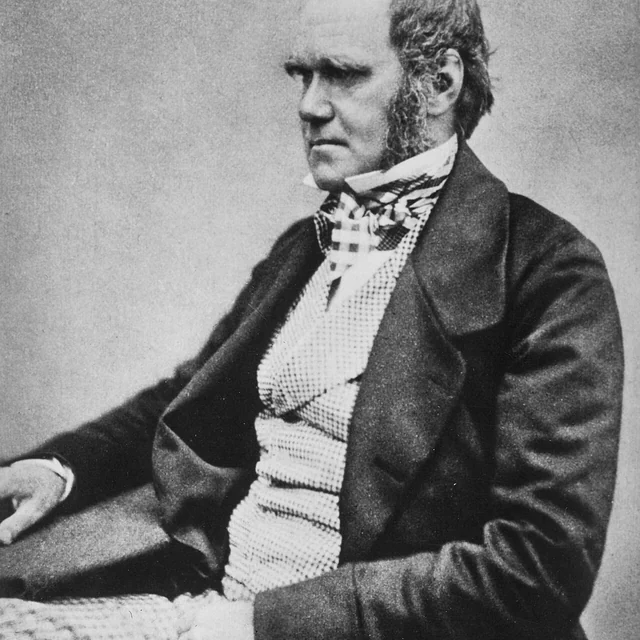
Charles Darwin
Charles Darwin (1809-1882) abandoned medicine at Edinburgh, drifted towards a country parsonage at Cambridge, and then spent five years as an unpaid naturalist aboard HMS Beagle. He came home in 1836 with the observations that would occupy him for the rest of his life, and then waited more than twenty years before publishing them. On the Origin of Species appeared in 1859 and sold out on the first day. He wrote nineteen books, kept up a correspondence of some 15,000 letters, was chronically ill for decades, and is buried in Westminster Abbey a few feet from Isaac Newton.
Photo: Charles_Darwin_seated.jpg : Henry Maull (1829–1914) and John Fox (1832–1907) (Maull & Fox) [ 3 ] derivative work: Bea o — Public domain, Wikimedia Commons
Search for Darwin quotes and the first result is almost always this: *It is not the strongest of the species that survives, nor the most intelligent, but the one most responsive to change.* It is carved on the floor of a United States federal building. Darwin never wrote it. The wording traces to Leon C. Megginson, a management professor at Louisiana State University, who paraphrased Darwin in a 1963 conference paper. The paraphrase escaped, lost its quotation marks, and came back as scripture.
From the end of On the Origin of Species
There is grandeur in this view of life, with its several powers, having been originally breathed into a few forms or into one. — *On the Origin of Species*, 1859, closing paragraph
From so simple a beginning endless forms most beautiful and most wonderful have been, and are being, evolved. — *On the Origin of Species*
Light will be thrown on the origin of man and his history. — *On the Origin of Species*, conclusion
I have called this principle, by which each slight variation, if useful, is preserved, by the term Natural Selection. — *On the Origin of Species*, chapter 4
I see no good reason why the views given in this volume should shock the religious feelings of any one. — *On the Origin of Species*
Great is the power of steady misrepresentation. — *On the Origin of Species*, sixth edition
From The Descent of Man
Ignorance more frequently begets confidence than does knowledge. — *The Descent of Man*, 1871, introduction
False facts are highly injurious to the progress of science, for they often endure long. — *The Descent of Man*
Man still bears in his bodily frame the indelible stamp of his lowly origin. — *The Descent of Man*, final page
Man is descended from a hairy, tailed quadruped, probably arboreal in its habits. — *The Descent of Man*
The highest possible stage in moral culture is when we recognise that we ought to control our thoughts. — *The Descent of Man*
There is no evidence that man was aboriginally endowed with the ennobling belief in the existence of an Omnipotent God. — *The Descent of Man*
From the notebooks, written while he was still afraid to say it
I think — Notebook B, 1837, written above the first sketch of an evolutionary tree
We can allow satellites, planets, suns, universe, nay whole systems of universes, to be governed by laws, but the smallest insect, we wish to be created at once by special act. — Notebook, 1838
Animals, whom we have made our slaves, we do not like to consider our equal. — Notebook B, 1837
From the letters
At last gleams of light have come, and I am almost convinced that species are not immutable. It is like confessing a murder. — to Joseph Dalton Hooker, 1844
How odd it is that anyone should not see that all observation must be for or against some view if it is to be of any service! — to Henry Fawcett, 1861
A scientific man ought to have no wishes, no affections, a mere heart of stone. — to Thomas Henry Huxley, 1860
It is a cursed evil to any man to become as absorbed in any subject as I am in mine. — letter, 1858
I love fools' experiments. I am always making them. — reported by his son Francis Darwin
I am not the least afraid to die. — his last days, recorded by Emma Darwin, 1882
To kill an error is as good a service as, and sometimes even better than, the establishing of a new truth or fact. — to Alfred Russel Wallace, 1879

From the Autobiography, written for his children
The voyage of the Beagle has been by far the most important event in my life and has determined my whole career. — *Autobiography*
I have steadily endeavoured to keep my mind free so as to give up any hypothesis, however much beloved, as soon as facts are shown to be opposed to it. — *Autobiography*
My mind seems to have become a kind of machine for grinding general laws out of large collections of facts. — *Autobiography*
If I had to live my life again, I would have made a rule to read some poetry and listen to some music at least once every week. — *Autobiography*
The loss of these tastes is a loss of happiness, and may possibly be injurious to the intellect, and more probably to the moral character. — *Autobiography*
The mystery of the beginning of all things is insoluble by us; and I for one must be content to remain an Agnostic. — *Autobiography*
Nothing before had ever made me thoroughly realise that science consists in grouping facts so that general laws or conclusions may be drawn from them. — *Autobiography*
I have called this a struggle for existence in a large and metaphorical sense. — *On the Origin of Species*, chapter 3
The passage about poetry and music is the one people find hardest to place, because it does not sound like a Victorian scientist congratulating himself. Darwin is describing a loss. He says that as a young man he was moved by Shakespeare and by paintings, and that after decades of grinding facts he could no longer feel any of it, and that he regarded this as a defect in his own mind.
Four attributed to him without a source
- "It is not the strongest of the species that survives, nor the most intelligent, but the one most responsive to change." Leon C. Megginson, 1963, paraphrasing the Origin in a talk to business academics. It is now quoted as Darwin on government buildings and in corporate reports.
- "Survival of the fittest" is not Darwin's phrase either. Herbert Spencer coined it in 1864; Darwin adopted it, with reservations, only from the fifth edition of the Origin onwards.
- "A man who dares to waste one hour of time has not discovered the value of life." Widely attributed, with no locus in any book, letter or notebook.
- "The love for all living creatures is the most noble attribute of man." A compression of a longer passage in The Descent of Man, quoted as though it were a sentence he wrote.
The adaptability quote is worth one last note, because the misattribution is not harmless. Megginson's version makes evolution sound like a lesson about flexibility and personal initiative, which is what made it useful to management writers. Darwin's actual argument is about differential reproduction across generations in populations, and it has nothing to say about whether an individual should be adaptable.
Did Darwin say survival of the fittest?
He used the phrase, but he did not invent it. Herbert Spencer coined it after reading the Origin, and Darwin adopted it from the fifth edition onwards at Alfred Russel Wallace's suggestion.
What is Darwin's most famous real quote?
The closing sentence of On the Origin of Species, about endless forms most beautiful. He revised it between editions and added the words "by the Creator" from the second edition onwards.
Where can I check a Darwin quote?
Darwin Online holds the complete published works, notebooks and manuscripts, and the Darwin Correspondence Project holds the letters. Both are free and searchable.
Sources
Keep reading
 Quotes & Sayings30 Nietzsche Quotes, and What "God Is Dead" Actually SaysThe most famous sentence in modern philosophy is usually read as a boast. In context it is spoken by a madman and it is a warning. Thirty quotes with the book and section number.
 Quotes & SayingsVan Gogh Wrote 800 Letters. Here Are 30 Lines From Them.Van Gogh sold almost nothing and explained almost everything, in letters mostly to his brother Theo. Thirty lines from the correspondence, plus four famous ones that appear nowhere in it.
 Quotes & Sayings30 Emily Dickinson Lines, With the Dashes Put BackDickinson published about ten poems in her lifetime and her editors removed her dashes, added titles and smoothed her rhymes. Thirty lines in the punctuation she actually used.
 Quotes & SayingsEpictetus Never Wrote a Word: 30 Quotes From a Student's NotesEverything attributed to Epictetus was written down by a student sitting in his classroom. Thirty lines with the chapter they come from, and five modern inventions that circulate under his name.