30 Nietzsche Quotes, and What "God Is Dead" Actually Says
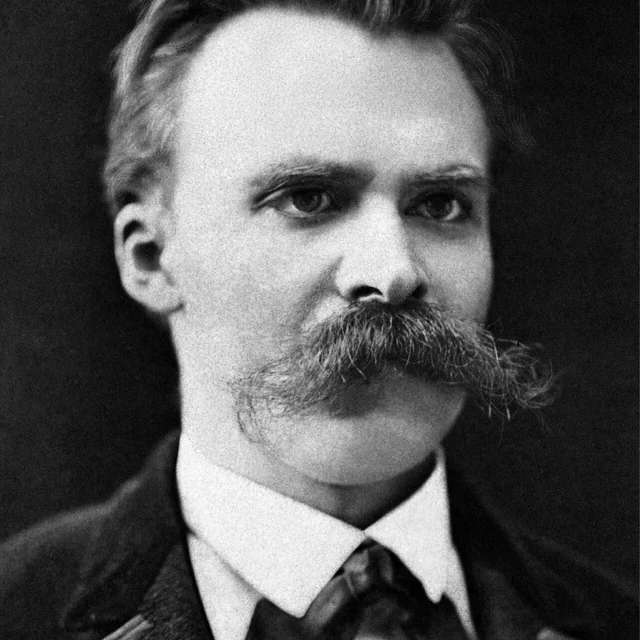
Friedrich Nietzsche
Friedrich Nietzsche (1844-1900) became a professor of classical philology at Basel at twenty-four, before finishing his doctorate, and resigned ten years later in poor health. He spent the following decade moving between boarding houses in Switzerland and Italy, writing the books nobody bought. In 1889 he collapsed in a street in Turin and never recovered his mind; he spent his last eleven years in the care of his mother and then his sister. His fame arrived during those silent years, shaped largely by that sister, who edited his notebooks to suit her own politics.
Photo: Friedrich Hermann Hartmann — Public domain, Wikimedia Commons
Start with the sentence everyone knows. In *The Gay Science* it is not Nietzsche speaking in his own voice and it is not a victory announcement. A madman runs into a marketplace with a lantern in the morning, shouting that he is looking for God, and the crowd laughs at him. He tells them they have killed God and asks how they intend to live with it. Then he smashes his lantern and says he has come too early. The passage is about the loss of a foundation, and the tone is closer to panic than to triumph.
The passage itself
God is dead. God remains dead. And we have killed him. How shall we comfort ourselves, the murderers of all murderers? — *The Gay Science*, §125
Who gave us the sponge to wipe away the entire horizon? What were we doing when we unchained this earth from its sun? — *The Gay Science*, §125
I have come too early, my time has not come yet. — *The Gay Science*, §125
The ones that survive being quoted alone
What does not kill me makes me stronger. — *Twilight of the Idols*, Maxims and Arrows, 8
He who has a why to live can bear almost any how. — *Twilight of the Idols*, Maxims and Arrows, 12
Without music, life would be a mistake. — *Twilight of the Idols*, Maxims and Arrows, 33
Is man merely a mistake of God's? Or God merely a mistake of man's? — *Twilight of the Idols*, Maxims and Arrows, 7
All truly great thoughts are conceived while walking. — *Twilight of the Idols*, Maxims and Arrows, 34
From Beyond Good and Evil
He who fights with monsters should look to it that he himself does not become a monster. And if you gaze long into an abyss, the abyss also gazes into you. — §146
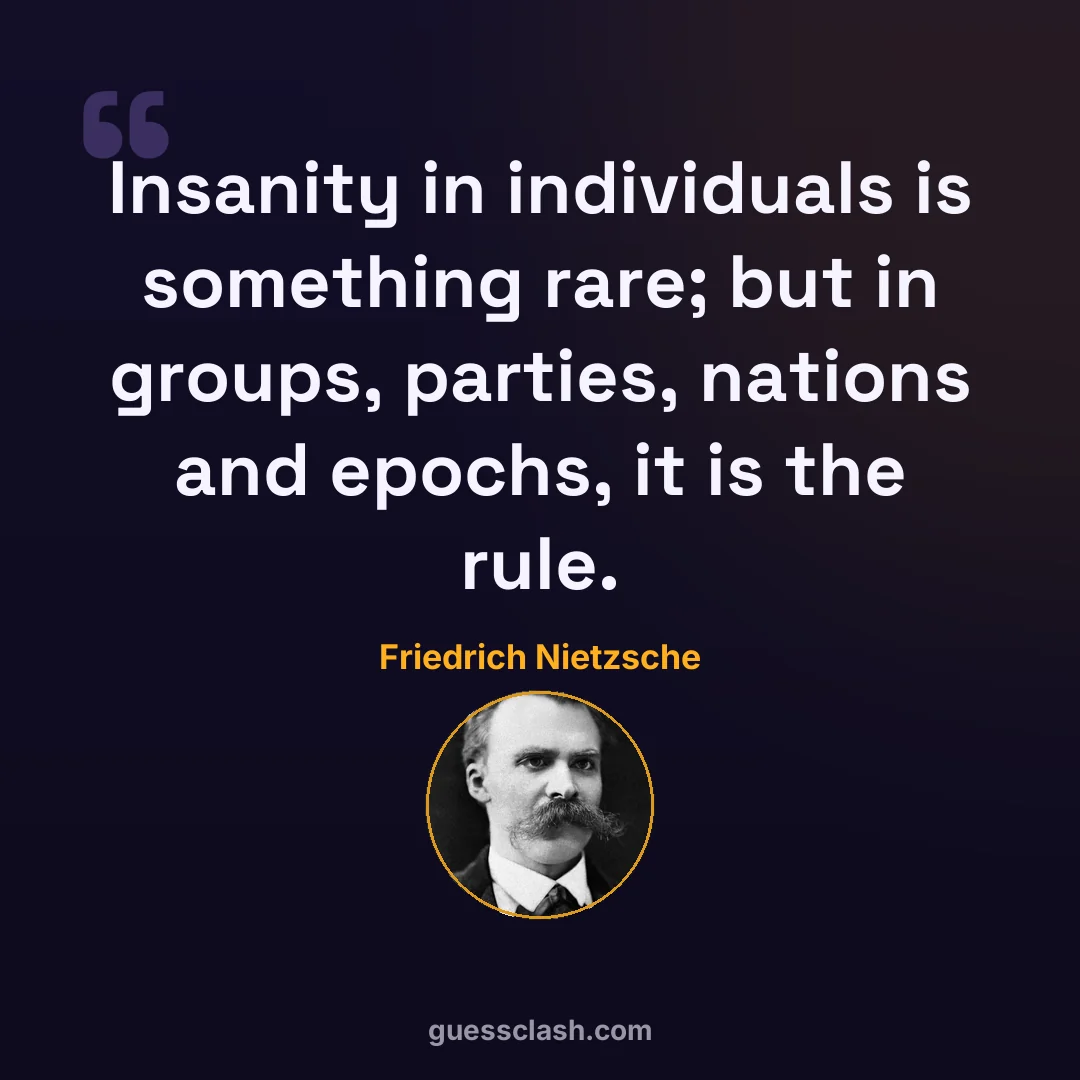
Insanity in individuals is something rare; but in groups, parties, nations and epochs, it is the rule. — §156
The thought of suicide is a great consolation: by means of it one gets through many a dark night. — §157
That which is done out of love always takes place beyond good and evil. — §153
Whoever despises himself still respects himself as one who despises. — §78
There are no moral phenomena at all, but only a moral interpretation of phenomena. — §108
From Thus Spoke Zarathustra
One must still have chaos in oneself to be able to give birth to a dancing star. — prologue
Man is something that shall be overcome. What have you done to overcome him? — prologue
There is always some madness in love. But there is also always some reason in madness. — Of Reading and Writing
One repays a teacher badly if one always remains nothing but a pupil. — Of the Bestowing Virtue
He who cannot obey himself will be commanded. — Of Self-Overcoming
Everything the State says is a lie, and everything it has it has stolen. — Of the New Idol
You have your way. I have my way. As for the right way, the correct way, and the only way, it does not exist. — Of the Spirit of Gravity
From the earlier books
Convictions are more dangerous enemies of truth than lies. — *Human, All Too Human*, §483
Hope is the worst of evils, for it prolongs the torment of man. — *Human, All Too Human*, §71
The surest way to corrupt a youth is to instruct him to hold in higher esteem those who think alike than those who think differently. — *Daybreak*, §297
Become who you are. — *The Gay Science*, §270, after Pindar
What if a demon crept after you one day and said: this life, as you now live it, you will have to live once more and innumerable times more? — *The Gay Science*, §341
We have art in order not to die of the truth. — from the unpublished notebooks, 1888
On his own difficulty
Whoever writes in blood and aphorisms does not want to be read, he wants to be learned by heart. — *Thus Spoke Zarathustra*
It is my ambition to say in ten sentences what everyone else says in a book. — *Twilight of the Idols*
Some men are born posthumously. — *The Antichrist*, foreword
There are no facts, only interpretations. — from the unpublished notebooks, 1886-87
Two of those are marked as notebooks rather than books, and the distinction matters more with Nietzsche than with almost any other writer. The Will to Power is not a book he wrote. It is a selection from his notes, assembled after his collapse by his sister Elisabeth Förster-Nietzsche, an antisemite and German nationalist who arranged the fragments to suit views her brother had attacked in print. Quotations from it are quotations from a compilation, and should be labelled as such.
Four he did not write
- "And those who were seen dancing were thought to be insane by those who could not hear the music." Perhaps the most widely shared Nietzsche quote online. It is in none of the books, the letters or the notebooks.
- "To live is to suffer, to survive is to find some meaning in the suffering." No source in Nietzsche. It reads like a compression of Viktor Frankl, who quoted Nietzsche's real "why and how" line in Man's Search for Meaning.
- "The individual has always had to struggle to keep from being overwhelmed by the tribe." No German original has ever been produced for it.
- "Nobody is more inferior than those who insist on being equal." Circulated politically, sourced to nothing.
The section numbers above are the practical fix. Nietzsche wrote in numbered aphorisms precisely so that a reader could hold a thought separately, which makes him the easiest major philosopher to cite exactly and, for the same reason, the easiest to quote out of the argument that surrounds it. Giving the number costs nothing and lets anyone read the paragraph before and after.
What did Nietzsche mean by God is dead?
That belief in the Christian God had ceased to be credible in European culture, and that nothing had yet replaced the foundation it provided for morality and meaning. In The Gay Science the line is spoken by a madman and framed as a crisis, not a celebration.
Did Nietzsche write The Will to Power?
No. It is a posthumous compilation of his notebooks, edited by his sister Elisabeth, who reordered the material and promoted readings her brother would have rejected.
Is "what does not kill me makes me stronger" a real quote?
Yes. It is the eighth of the Maxims and Arrows in Twilight of the Idols, published in 1888, and reads literally: what does not kill me makes me stronger.
Sources
Keep reading
 Quotes & SayingsVan Gogh Wrote 800 Letters. Here Are 30 Lines From Them.Van Gogh sold almost nothing and explained almost everything, in letters mostly to his brother Theo. Thirty lines from the correspondence, plus four famous ones that appear nowhere in it.
 Quotes & SayingsDarwin's Most Quoted Sentence Is Not His: 30 That AreThe line about the species most adaptable to change was written by a business professor in 1963. Thirty quotes that really are Darwin's, from the books, the notebooks and the letters.
 Quotes & Sayings30 Emily Dickinson Lines, With the Dashes Put BackDickinson published about ten poems in her lifetime and her editors removed her dashes, added titles and smoothed her rhymes. Thirty lines in the punctuation she actually used.
 Quotes & SayingsEpictetus Never Wrote a Word: 30 Quotes From a Student's NotesEverything attributed to Epictetus was written down by a student sitting in his classroom. Thirty lines with the chapter they come from, and five modern inventions that circulate under his name.