Epictetus Never Wrote a Word: 30 Quotes From a Student's Notes
Epictetus
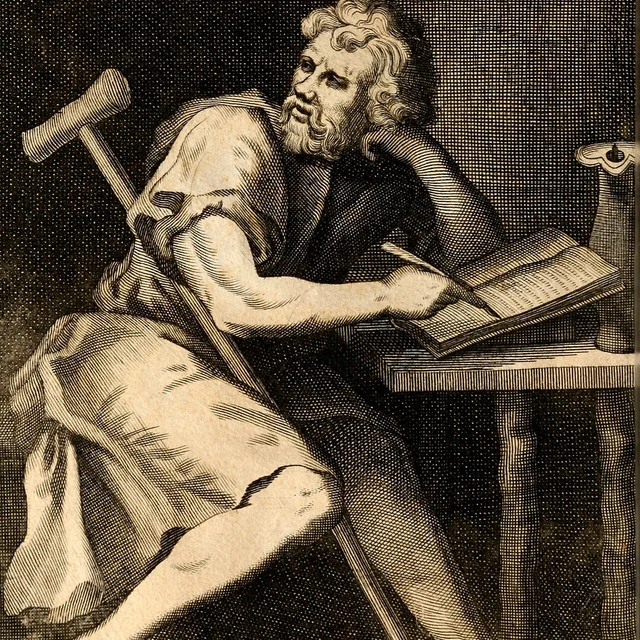
Epictetus (c. AD 50 - c. 135) was born enslaved in Phrygia and spent his early life in Rome as the property of a secretary to Nero. He was permitted to study philosophy while still enslaved, was freed at some point after Nero's death, and taught until Domitian expelled philosophers from Italy. He then opened a school at Nicopolis in Greece that drew Roman senators' sons. He owned almost nothing, lived alone in a house with no door to lock, and adopted a child late in life. He wrote nothing at all.
Photo: William Sonmans / Michael Burghers — Public domain, Wikimedia Commons
Epictetus left no books. What survives is the lecture notes of Arrian, a student who later became a Roman governor and a historian of Alexander, and who insisted he had written down his teacher's actual words rather than composing anything of his own. The most quoted Stoic in the world is therefore a transcript. The short handbook called the Enchiridion is a condensed selection from those notes, and it is where most of the lines below come from.
The one idea everything else hangs on
Some things are in our power and others are not. — *Enchiridion*, 1
Men are disturbed not by things, but by the views which they take of things. — *Enchiridion*, 5
Seek not that the things which happen should happen as you wish; but wish the things which happen to be as they are, and you will have a tranquil flow of life. — *Enchiridion*, 8
Disease is an impediment to the body, but not to the will, unless the will itself chooses. — *Enchiridion*, 9
On the occasion of every accident that befalls you, remember to turn to yourself and inquire what faculty you have for its use. — *Enchiridion*, 10
On loss, which he expected you to rehearse
Never say about anything, I have lost it, but say I have restored it. — *Enchiridion*, 11
If you wish your children and your wife and your friends to live forever, you are silly; for you wish things to be in your power which are not. — *Enchiridion*, 14
Let death and exile and all other things which appear terrible be daily before your eyes, but most of all death. — *Enchiridion*, 21
Remember that you must behave as at a banquet. Is anything brought round to you? Put out your hand and take a moderate share. — *Enchiridion*, 15
On other people's opinion of you
If you want to improve, be content to be thought foolish and stupid. — *Enchiridion*, 13
It is not he who reviles you or strikes you who insults you, but your opinion about these things as being insulting. — *Enchiridion*, 20
You can be invincible if you enter into no contest in which it is not in your power to conquer. — *Enchiridion*, 19
On no occasion call yourself a philosopher. Sheep do not throw up the grass to show the shepherds how much they have eaten. — *Enchiridion*, 46
Be for the most part silent, or speak merely what is necessary, and in few words. — *Enchiridion*, 33
On judging what happens
Everything has two handles, the one by which it may be borne, the other by which it may not. — *Enchiridion*, 43
Remember that you are an actor in a play, the character of which is determined by the author. Your business is to act well the part that is given to you. — *Enchiridion*, 17
When you see a person weeping in sorrow, take care not to be carried away by the appearance, as if he were suffering in externals. — *Enchiridion*, 16
The condition and characteristic of an uninstructed person is this: he never expects from himself profit nor harm, but from externals. — *Enchiridion*, 48
Whatever rules you have adopted, abide by them as laws. — *Enchiridion*, 50
From the Discourses, where he is talking rather than summarising
No great thing is created suddenly, any more than a bunch of grapes or a fig. — *Discourses*, I.15
It is not death or pain that is to be feared, but the fear of pain or death. — *Discourses*, II.1
It is impossible for a man to learn what he thinks he already knows. — *Discourses*, II.17
First say to yourself what you would be; and then do what you have to do. — *Discourses*, III.23
If you would be a reader, read; if a writer, write. — *Discourses*, II.18
On freedom, from a man who had been owned
He is free who lives as he wishes to live, who is neither subject to compulsion nor to hindrance. — *Discourses*, IV.1
Freedom is not procured by a full enjoyment of what is desired, but by controlling the desire. — *Discourses*, IV.1
Only the educated are free. — *Discourses*, II.1
Practise yourself, for heaven's sake, in little things; and thence proceed to greater. — *Discourses*, IV.1
I must die. Must I then die lamenting? I must be put in chains. Must I then also lament? — *Discourses*, I.1
Know first who you are, and then adorn yourself accordingly. — *Discourses*, III.1
Nature has given us one tongue but two ears, that we may hear from others twice as much as we speak. — *Fragments*, preserved by Stobaeus
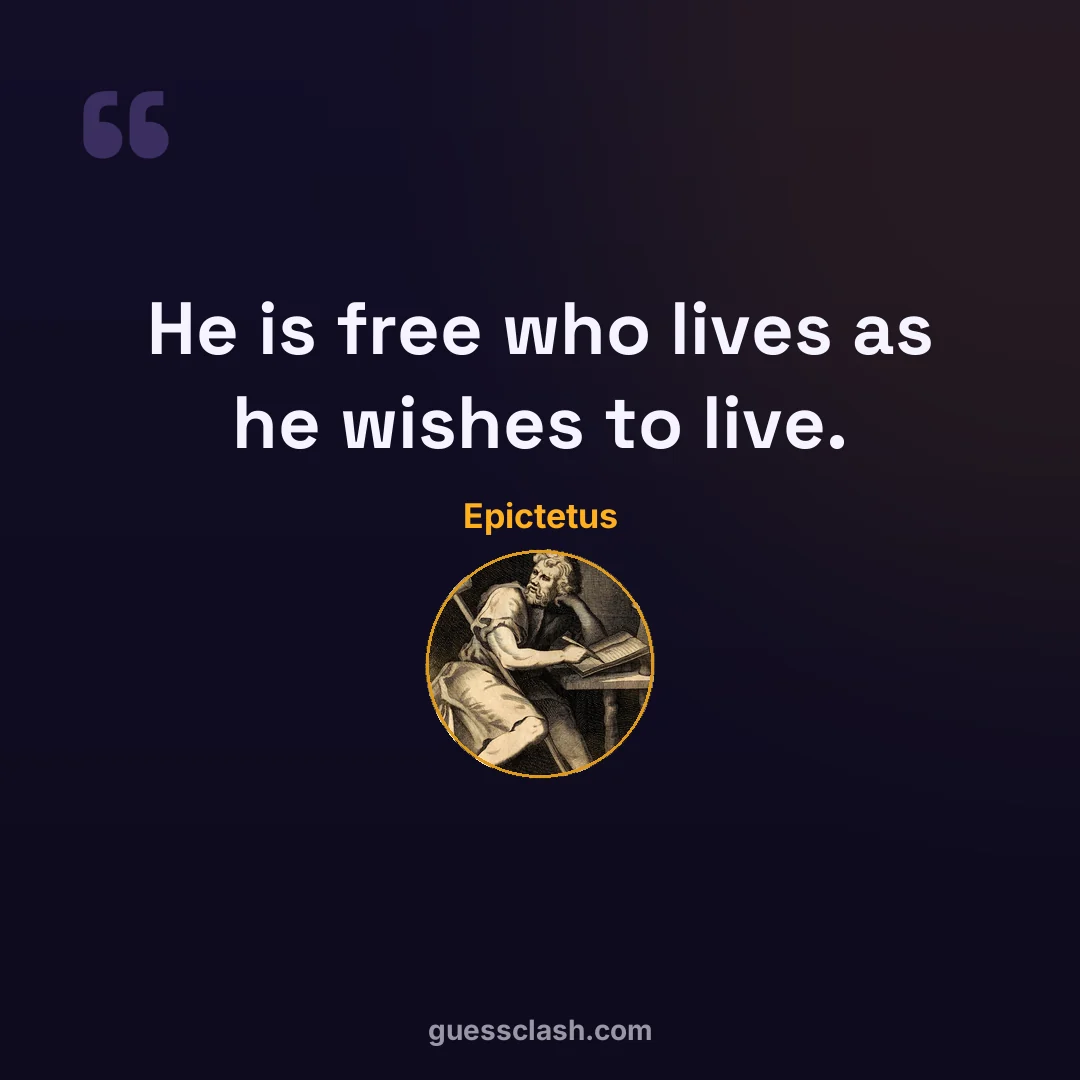
The freedom passages are the ones worth slowing down for. Epictetus spent years as another man's property, and the distinction he keeps drawing between what can be taken from you and what cannot is not a thought experiment. Ancient sources say his leg was permanently damaged by his owner. His answer was not that the injury did not matter but that it belonged to a category he had no vote in, and that the vote he did have was elsewhere.
Five modern lines that circulate as his
- "Don't explain your philosophy. Embody it." A twentieth-century compression. It captures Enchiridion 46 fairly, but no translator has ever printed that sentence.
- "Wealth consists not in having great possessions, but in having few wants." Attached to Epictetus, to Socrates and to Seneca in roughly equal numbers, and sourced to none of them.
- "Circumstances don't make the man, they only reveal him to himself." Modern phrasing, no passage behind it.
- "Any person capable of angering you becomes your master." A real Stoic idea rewritten as a slogan. It is not a translation of anything in the Discourses.
- "He who laughs at himself never runs out of things to laugh at." No classical source at all.
The pattern is worth noticing across all five: each fake is a tidier, punchier version of something Epictetus really argued. That is why they spread. The originals are longer, more conditional and more argumentative, because they were spoken to a room of students who could interrupt.
What is the Enchiridion?
A short handbook, about fifty brief chapters, selected and condensed from the Discourses by Arrian. The Greek word means something held in the hand, and it was designed to be carried and reread.
Did Epictetus write the Discourses?
No. Arrian, one of his students, took them down and published them. Arrian's covering letter insists he wrote nothing of his own and preserved the teacher's wording as far as he could.
Was Epictetus really a slave?
Yes. He was owned by Epaphroditus, a freedman who served as a secretary to Nero, and was freed at some point after Nero's death in AD 68.
Sources
Keep reading
 Quotes & Sayings30 Nietzsche Quotes, and What "God Is Dead" Actually SaysThe most famous sentence in modern philosophy is usually read as a boast. In context it is spoken by a madman and it is a warning. Thirty quotes with the book and section number.
 Quotes & SayingsVan Gogh Wrote 800 Letters. Here Are 30 Lines From Them.Van Gogh sold almost nothing and explained almost everything, in letters mostly to his brother Theo. Thirty lines from the correspondence, plus four famous ones that appear nowhere in it.
 Quotes & SayingsDarwin's Most Quoted Sentence Is Not His: 30 That AreThe line about the species most adaptable to change was written by a business professor in 1963. Thirty quotes that really are Darwin's, from the books, the notebooks and the letters.
 Quotes & Sayings30 Emily Dickinson Lines, With the Dashes Put BackDickinson published about ten poems in her lifetime and her editors removed her dashes, added titles and smoothed her rhymes. Thirty lines in the punctuation she actually used.