30 Emily Dickinson Lines, With the Dashes Put Back
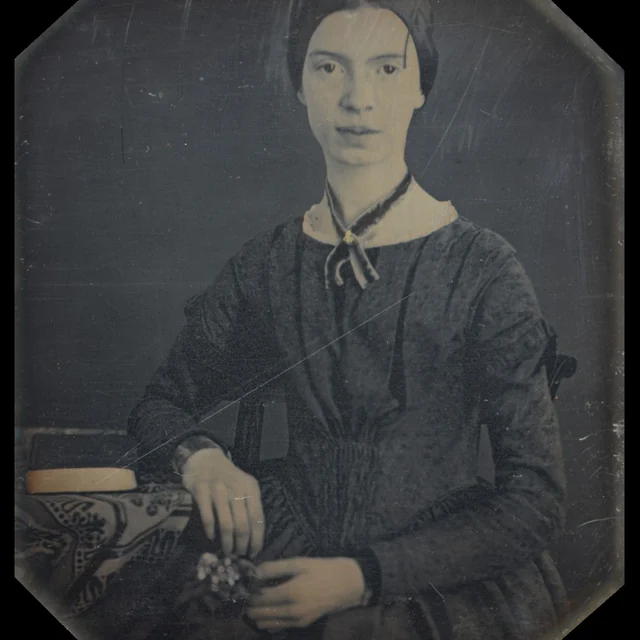
Emily Dickinson
Emily Dickinson (1830-1886) lived almost her whole life in one house in Amherst, Massachusetts, and in her last years rarely left her room. She wrote roughly 1,800 poems and hand-sewed most of them into small booklets that nobody saw. Fewer than a dozen appeared in print while she was alive, published anonymously and heavily altered by editors. Her sister Lavinia found the rest in a locked box after her death. The first collections of the 1890s regularised her punctuation and rhyme; the poems were not printed as she wrote them until Thomas H. Johnson's edition of 1955.
Photo: Unknown author Unknown author — Public domain, Wikimedia Commons
Dickinson wrote in dashes. Not commas, not full stops, but a mark that hangs between words and refuses to settle them. Her first editors thought this was carelessness and cleaned it up, gave the poems titles she never wrote, and rhymed her half-rhymes properly. The version of Dickinson most people quote is the tidied one. The lines below use the punctuation of the manuscripts, which is the whole point of her.
The famous openings
"Hope" is the thing with feathers – / That perches in the soul – — Fr314
Because I could not stop for Death – / He kindly stopped for me – — Fr479
I'm Nobody! Who are you? / Are you – Nobody – too? — Fr260
I heard a Fly buzz – when I died – — Fr591
Wild nights – Wild nights! / Were I with thee — Fr269
On truth and telling it
Tell all the truth but tell it slant – / Success in Circuit lies — Fr1263
The Truth must dazzle gradually / Or every man be blind – — Fr1263
Much Madness is divinest Sense – / To a discerning Eye – — Fr620
A word is dead / When it is said, / Some say. / I say it just / Begins to live / That day. — Fr278
On the size of a mind
The Brain – is wider than the Sky – / For – put them side by side – — Fr598
I dwell in Possibility – / A fairer House than Prose – — Fr466
There is no Frigate like a Book / To take us Lands away — Fr1286
The Soul selects her own Society – / Then – shuts the Door – — Fr409

On pain, which she wrote about more precisely than anyone
After great pain, a formal feeling comes – / The Nerves sit ceremonious, like Tombs – — Fr372
They say that "Time assuages" – / Time never did assuage – — Fr861
Water, is taught by thirst. / Land – by the Oceans passed. — Fr93
Parting is all we know of heaven, / And all we need of hell. — Fr1773
Success is counted sweetest / By those who ne'er succeed. — Fr112
On time and what is left
Forever – is composed of Nows – — Fr690
That it will never come again / Is what makes life so sweet. — Fr1761
If I can stop one Heart from breaking / I shall not live in vain — Fr982
This is my letter to the World / That never wrote to Me – — Fr519
Beauty – be not caused – It Is – — Fr654
The poem numbers above follow R. W. Franklin's 1998 edition, which is why they begin with Fr. Older books use Johnson's 1955 numbering, so the same poem can carry two different numbers, and the anthologies of the 1890s give titles instead. If a line is quoted to you as "The Chariot", that is an editor's title for the poem that begins *Because I could not stop for Death*.
From the letters, where she is funnier
If I read a book and it makes my whole body so cold no fire can ever warm me, I know that is poetry. — reported by T. W. Higginson
To live is so startling it leaves little time for anything else. — letter
I am out with lanterns, looking for myself. — letter
My friends are my estate. — letter to Samuel Bowles
Nature is a Haunted House – but Art – a House that tries to be haunted. — letter to T. W. Higginson
Saying nothing sometimes says the Most. — letter
Dying is a wild night and a new road. — letter
The Heart wants what it wants – or else it does not care – — letter
What the first editors changed
- The dashes went. Mabel Loomis Todd and T. W. Higginson replaced them with commas, semicolons and full stops, which closes down lines Dickinson left open.
- Titles were invented. She titled almost nothing. *The Chariot*, *The Snake* and *Aspiration* are editorial, not hers.
- Rhymes were corrected. Her half-rhymes were treated as mistakes and smoothed into full ones, removing the deliberate scrape.
- Capitals were levelled. She capitalised nouns irregularly and for emphasis; early editions standardised them away.
- Whole stanzas were cut where an editor found the sense obscure, without any note to the reader.
It took until 1955 for a complete edition in her own punctuation, and until the Emily Dickinson Archive put the manuscripts online for anyone to see how the pages actually look: dashes at different angles, words with two or three alternatives listed underneath, poems that never chose between them. Quoting her accurately means quoting something she left unfinished on purpose.
How many poems did Emily Dickinson publish in her lifetime?
About ten, out of roughly 1,800. They appeared anonymously in newspapers and were altered by editors, which is one reason she stopped seeking publication.
Why does Emily Dickinson use so many dashes?
They hold a phrase open rather than closing it, and they let a line mean two things at once. Her editors read them as unfinished punctuation and removed them for sixty years.
What do the Fr numbers mean?
They are the poem numbers in R. W. Franklin's 1998 variorum edition. An older system, prefixed J, comes from Thomas H. Johnson's 1955 edition.
Sources
Keep reading
 Quotes & Sayings30 Nietzsche Quotes, and What "God Is Dead" Actually SaysThe most famous sentence in modern philosophy is usually read as a boast. In context it is spoken by a madman and it is a warning. Thirty quotes with the book and section number.
 Quotes & SayingsVan Gogh Wrote 800 Letters. Here Are 30 Lines From Them.Van Gogh sold almost nothing and explained almost everything, in letters mostly to his brother Theo. Thirty lines from the correspondence, plus four famous ones that appear nowhere in it.
 Quotes & SayingsDarwin's Most Quoted Sentence Is Not His: 30 That AreThe line about the species most adaptable to change was written by a business professor in 1963. Thirty quotes that really are Darwin's, from the books, the notebooks and the letters.
 Quotes & SayingsEpictetus Never Wrote a Word: 30 Quotes From a Student's NotesEverything attributed to Epictetus was written down by a student sitting in his classroom. Thirty lines with the chapter they come from, and five modern inventions that circulate under his name.