30 Seneca Quotes From Letters He Wrote to One Friend
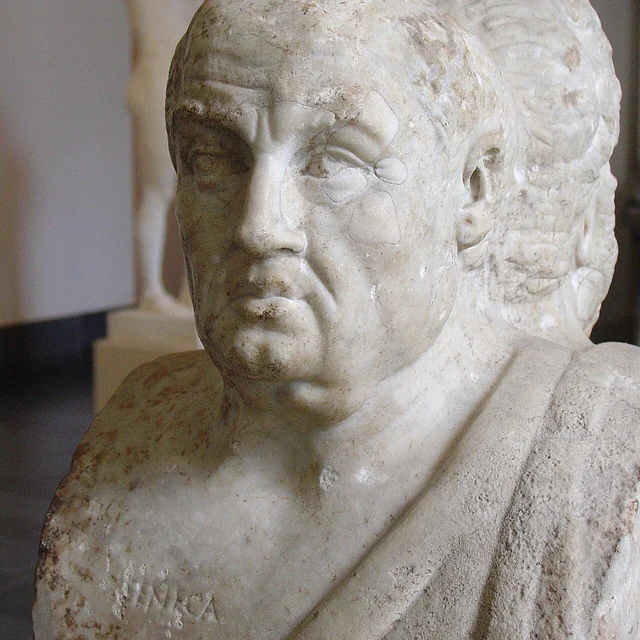
Seneca
Lucius Annaeus Seneca (c. 4 BC - AD 65) was a Roman senator, playwright and Stoic philosopher who spent eight years as tutor and adviser to the emperor Nero. He was exiled to Corsica, recalled, made enormously rich by imperial favour, and finally ordered to kill himself after being accused of conspiracy. The contradiction between his wealth and his writing on simplicity was noticed in his own lifetime and he answered it directly. His Moral Letters to Lucilius, written in his last years, are the source of most of the lines attributed to him today.
Photo: Calidius — CC BY-SA 3.0, Wikimedia Commons
Almost everything people quote as Seneca comes from one place: a run of letters written near the end of his life to Lucilius, a friend who was governing Sicily. They are not a system. They are advice from a man who knew he was out of favour with Nero and probably did not have long, and the urgency shows in every paragraph about wasted time.
On time, which he treated as the only real possession
It is not that we have a short time to live, but that we waste a lot of it. — *On the Shortness of Life*
While we are postponing, life speeds by. — *Moral Letters*, 1
Nothing is ours except time. — *Moral Letters*, 1
Life is long, if you know how to use it. — *On the Shortness of Life*
The greatest obstacle to living is expectancy, which hangs upon tomorrow and loses today. — *On the Shortness of Life*

On fear, and the damage done in advance
We suffer more often in imagination than in reality. — *Moral Letters*, 13
What I advise you to do is, not to be unhappy before the crisis comes. — *Moral Letters*, 13
Cease to hope, and you will cease to fear. — *Moral Letters*, 5
The mind that is anxious about the future is miserable. — *Moral Letters*, 98
You act like mortals in all that you fear, and like immortals in all that you desire. — *On the Shortness of Life*
The letters keep returning to a single practical claim: most suffering is rehearsal. Seneca is not saying the bad thing will not happen. He is saying that you will live through it once when it arrives and a hundred times before, and that only one of those hundred is unavoidable.
On death, which he expected
Sometimes even to live is an act of courage. — *Moral Letters*, 78
He who fears death will never do anything worthy of a man who is alive. — *Moral Letters*, 78
Begin at once to live, and count each separate day as a separate life. — *Moral Letters*, 101
Let us prepare our minds as if we had come to the very end of life. — *Moral Letters*, 101

On money, from a man who had a great deal of it
It is not the man who has too little, but the man who craves more, that is poor. — *Moral Letters*, 2
Poverty brought into conformity with the law of nature is great wealth. — *Moral Letters*, 4
He is a great man who uses earthenware dishes as if they were silver; but he is equally great who uses silver as if it were earthenware. — *Moral Letters*, 5
It is quality rather than quantity that matters. — *Moral Letters*, 45
On other people
To be everywhere is to be nowhere. — *Moral Letters*, 2
Associate with those who will make a better man of you. — *Moral Letters*, 7
I never come back home with quite the same moral character I went out with. — *Moral Letters*, 7
Men learn while they teach. — *Moral Letters*, 7

On hard going
It is a rough road that leads to the heights of greatness. — *Moral Letters*, 84
Fire tests gold, suffering tests brave men. — *Of Providence*
Disaster is virtue's opportunity. — *Of Providence*
There is no easy way from the earth to the stars. — *Hercules Furens*
A great fortune is a great slavery. — *Consolation to Polybius*
On learning and direction
As long as you live, keep learning how to live. — *Moral Letters*, 76
If a man knows not to which port he sails, no wind is favourable. — *Moral Letters*, 71
Nothing is a better proof of a well-ordered mind than a man's ability to stop just where he is and pass some time in his own company. — *Moral Letters*, 2
It is not because things are difficult that we do not dare; it is because we do not dare that they are difficult. — *Moral Letters*, 104
I examine my whole day and go back over what I have done and said, concealing nothing from myself, passing nothing by. — *On Anger*, III

Four lines he is credited with and did not write
- "Luck is what happens when preparation meets opportunity." Attached to Seneca all over the internet and absent from every surviving work. The phrasing is twentieth-century American.
- "Every new beginning comes from some other beginning's end." A line from the 1998 Semisonic song *Closing Time*, sometimes dressed up as a translation of Seneca.
- "Throw me to the wolves and I will return leading the pack." No classical source at all. It circulates as Seneca, as Nietzsche and as anonymous, which is usually the sign of an invention.
- "A gem cannot be polished without friction, nor a man perfected without trials." Attributed to Seneca and to Confucius in roughly equal measure, and found in neither.
The gap between Seneca's writing and his life was the standard charge against him in antiquity, and it is still the first thing critics raise. He was one of the richest men in Rome while writing about the sufficiency of little. He answered in *On the Happy Life*: he never claimed to be a wise man, only to be moving towards wisdom, and a doctor who is himself ill can still prescribe correctly. Readers can decide how far that covers it.
What is Seneca's most famous quote?
The opening claim of On the Shortness of Life: that our problem is not the length of life but the waste of it. It is the line most often reproduced, and unlike much of what circulates under his name it is genuinely his.
Did Seneca write the Moral Letters as real letters?
They are addressed to a real person, Lucilius Junior, but they were almost certainly shaped for publication. Seneca expected them to be read by strangers and says so inside the letters themselves.
Why is Seneca associated with Stoicism?
He is one of three Roman Stoics whose work survives in quantity, alongside Epictetus and Marcus Aurelius. Of the three he is the most readable, which is why he is quoted most.
Sources
Keep reading
 Quotes & Sayings30 Nietzsche Quotes, and What "God Is Dead" Actually SaysThe most famous sentence in modern philosophy is usually read as a boast. In context it is spoken by a madman and it is a warning. Thirty quotes with the book and section number.
 Quotes & SayingsVan Gogh Wrote 800 Letters. Here Are 30 Lines From Them.Van Gogh sold almost nothing and explained almost everything, in letters mostly to his brother Theo. Thirty lines from the correspondence, plus four famous ones that appear nowhere in it.
 Quotes & SayingsDarwin's Most Quoted Sentence Is Not His: 30 That AreThe line about the species most adaptable to change was written by a business professor in 1963. Thirty quotes that really are Darwin's, from the books, the notebooks and the letters.
 Quotes & Sayings30 Emily Dickinson Lines, With the Dashes Put BackDickinson published about ten poems in her lifetime and her editors removed her dashes, added titles and smoothed her rhymes. Thirty lines in the punctuation she actually used.