30 Marcus Aurelius Quotes From a Notebook He Never Meant You to Read
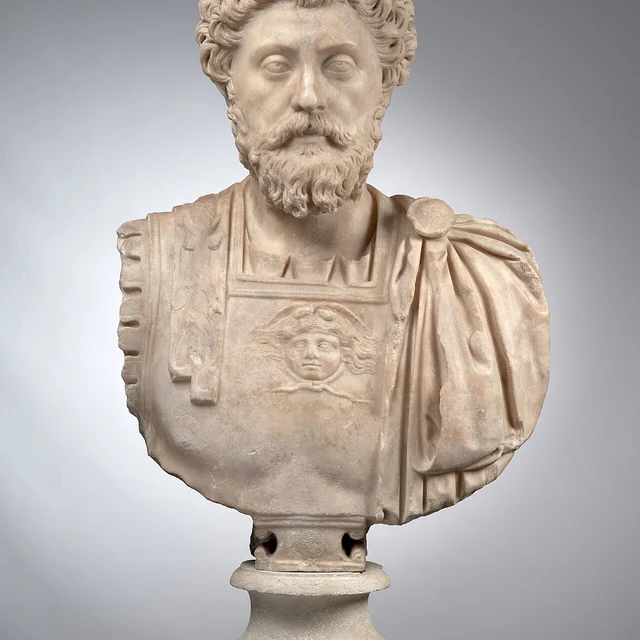
Marcus Aurelius
Marcus Aurelius ruled Rome from AD 161 to 180, the last of the emperors later called the Five Good Emperors. He spent much of his reign at war on the Danube frontier and much of the rest managing plague, floods and a rebellion by a trusted general. In camp he kept a private notebook in Greek, addressed to nobody, reminding himself how to behave. It was never titled and never meant for publication; we call it the Meditations. He died at fifty-eight, probably of plague, and left the empire to his son Commodus, which is the one decision history has never let him forget.
Photo: Daniel Martin — CC BY-SA 4.0, Wikimedia Commons
There is a strange thing about the Meditations: it is not addressed to us. Marcus Aurelius wrote in Greek, in the second person, to himself, mostly in army camps on the Danube. He is not teaching. He is arguing with a man who keeps wanting to lie in bed, keeps getting irritated by colleagues, keeps forgetting that he will die.
That is why the lines below survive being quoted. They were written by someone with absolute power who could not get his own temper under control, and knew it.
On starting the day
In the morning when you rise unwillingly, let this thought be present: I am rising to the work of a human being.
Begin the morning by saying to yourself: I shall meet with the busybody, the ungrateful, the arrogant, the deceitful, the envious, the unsocial. All these things happen to them by reason of their ignorance of what is good and evil.
Do not act as if you were going to live ten thousand years. While you live, while it is in your power, be good.
Since it is possible that you may depart from life this very moment, regulate every act and thought accordingly.
Book Two opens with the busybody passage, and it is a reminder rather than a complaint: he lists the people who will annoy him before he meets them, so that the annoyance arrives already expected.

On other people
Waste no more time arguing about what a good man should be. Be one.
The best revenge is to be unlike him who performed the injury.
How much time he gains who does not look to see what his neighbour says or does or thinks.
Accept the things to which fate binds you, and love the people with whom fate brings you together, but do so with all your heart.
That which is not good for the swarm, neither is it good for the bee.
It is the act of an ill-instructed man to blame others for his own bad condition; it is the act of one who has begun to be instructed to lay the blame on himself; and of one whose instruction is completed, neither to blame another, nor himself.
On what is actually in your control
You have power over your mind, not over outside events. Realise this, and you will find strength.
If you are distressed by anything external, the pain is not due to the thing itself but to your own estimate of it; and this you have the power to revoke at any moment.
Take away your opinion, and there is taken away the complaint. Take away the complaint, and the hurt is gone.
Consider that everything is opinion, and opinion is in your power.
Nowhere can a man find a quieter or more untroubled retreat than in his own soul.

On change and time
The universe is change; our life is what our thoughts make it.
Time is a sort of river of passing events, and strong is its current; no sooner is a thing brought to sight than it is swept by and another takes its place.
Loss is nothing else but change, and change is Nature's delight.
Whatever happens to you has been waiting to happen since the beginning of time.
Confine yourself to the present.
Everything that happens happens as it should, and if you observe carefully, you will find this to be so.
On character
The soul becomes dyed with the colour of its thoughts.
If it is not right, do not do it; if it is not true, do not say it.
Look within. Within is the fountain of good, and it will ever bubble up, if you will ever dig.
Be like the cliff against which the waves continually break; it stands firm and tames the fury of the water around it.
Perfection of character is this: to live each day as if it were your last, without frenzy, without apathy, without pretence.
Very little is needed to make a happy life; it is all within yourself, in your way of thinking.

On death, without the drama
Do every act of your life as though it were the last act of your life.
Nothing happens to any man which he is not formed by nature to bear.
Man is a little soul carrying about a corpse, as Epictetus used to say.
Never let the future disturb you. You will meet it, if you have to, with the same weapons of reason which today arm you against the present.
He who lives in harmony with himself lives in harmony with the universe.

One line that is not his
You will see "Death smiles at us all; all a man can do is smile back" attributed to Marcus Aurelius on a great many posters. It is not in the Meditations. It is a line spoken by his character in the film *Gladiator*, written in 2000. The film is good; the attribution is invented.
How to read him without the poster effect
Almost every line above is a correction. He writes that revenge is pointless because he wants revenge. He writes about not caring what neighbours think because he cares. Read as advice from a serene man, the Meditations is smug. Read as a to-do list written by an anxious one, it is something else entirely — and far more useful.
Did Marcus Aurelius write the Meditations for publication?
No. It was a private notebook, written in Greek and addressed to himself, with no title and no reader in mind. The first surviving mention of it comes centuries after his death.
Which translation of the Meditations should I read?
George Long's nineteenth-century translation is free and public domain, and most older quotations come from it. Modern translations by Gregory Hays and Robin Waterfield read more naturally if you want plain contemporary English.
Was Marcus Aurelius a Stoic philosopher?
He was a Stoic, but not a professional philosopher. He was an emperor who practised Stoicism, and the Meditations is closer to a training diary than to a philosophical treatise.