Leonardo da Vinci in 30 Quotes: Work, Seeing, and Never Finishing Anything
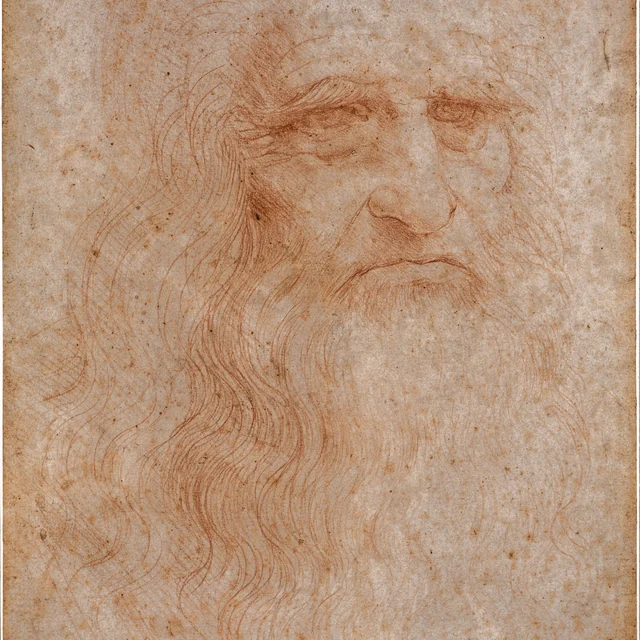
Leonardo da Vinci
Leonardo da Vinci (1452-1519) was born near Vinci in Tuscany, the illegitimate son of a notary, which barred him from university and pushed him into a painter's workshop instead. He finished remarkably few paintings and left behind roughly seven thousand pages of notes on anatomy, water, flight, optics, geology and machines, written right to left in mirror script. Most of it was unpublished for centuries. He spent his last years in France as a guest of Francis I, still revising the Mona Lisa, which he never handed over to the man who commissioned it.
Photo: Leonardo da Vinci — Public domain, Wikimedia Commons
Leonardo's notebooks are not a philosophy. They are a working record: measurements, sketches, shopping lists, arguments with himself, and every so often a sentence that stops you. He wrote them in mirror script, left-handed, with no plan to publish.
Read together, the lines below say something consistent. Look harder, work from what you can see, distrust authority, and expect the work to take longer than you promised.
On seeing
All our knowledge has its origin in our perceptions.
The eye, which is called the window of the soul, is the principal means by which the understanding may most fully appreciate the infinite works of nature.
Look at walls splashed with a number of stains, or stones of various mixed colours. If you have to invent some scene, you can see there resemblances to a number of landscapes.
He who can copy can create.
Nature never breaks her own laws.
Human subtlety will never devise an invention more beautiful, more simple or more direct than does Nature, because in her inventions nothing is lacking and nothing is superfluous.

On work and its cost
It is easier to resist at the beginning than at the end.
Iron rusts from disuse; water loses its purity from stagnation. Even so does inaction sap the vigour of the mind.
There are three classes of people: those who see, those who see when they are shown, those who do not see.
Art is never finished, only abandoned.
Obstacles cannot crush me. Every obstacle yields to stern resolve.
Time stays long enough for anyone who will use it.
As a well-spent day brings happy sleep, so a life well used brings happy death.
On learning and teachers
Study without desire spoils the memory, and it retains nothing that it takes in.
Anyone who conducts an argument by appealing to authority is not using his intelligence; he is just using his memory.
Experience does not err. Only your judgements err by expecting from her what is not in her power.
Poor is the pupil who does not surpass his master.
Learning never exhausts the mind.
Those who fall in love with practice without science are like a sailor who enters a ship without a helm or compass, and who never can be certain whither he is going.
On simplicity and craft
Simplicity is the ultimate sophistication.
The painter who draws merely by practice and by eye, without any reason, is like a mirror which copies everything placed in front of it without being conscious of their existence.
A painter should begin every canvas with a wash of black, because all things in nature are dark except where exposed by the light.
Details make perfection, and perfection is not a detail.
Where the spirit does not work with the hand, there is no art.
Notice how often he writes about unfinished work. Leonardo left the Adoration of the Magi as bare underdrawing, abandoned the Battle of Anghiari after the paint refused to dry, and carried the Mona Lisa around for years without delivering it. The lines about resisting at the beginning and about art being abandoned are not aphorisms he collected; they are a man describing his own working life.
On living with yourself
One can have no smaller or greater mastery than mastery of oneself.
He who does not punish evil commands it to be done.
The greatest deception men suffer is from their own opinions.
While I thought that I was learning how to live, I have been learning how to die.
Nothing strengthens authority so much as silence.
You do ill if you praise, but worse if you censure, what you do not rightly understand.
A note on where these come from
Almost everything above survives because of one accident: Leonardo left his papers to his pupil Francesco Melzi, who kept them. They were later broken up, sold and scattered across collections in Milan, Paris, Windsor, Madrid and London, and one codex now belongs to Bill Gates.
The standard English source is Jean Paul Richter's *The Literary Works of Leonardo da Vinci*, published in 1883 and long out of copyright, and Edward MacCurdy's later selection. A few lines attached to Leonardo's name online — including several about flight and about wanting to be free — do not appear in either.
Did Leonardo really write backwards?
Yes. Most of the notebooks are in mirror script, running right to left. He was left-handed, and writing that way avoided smudging wet ink; there is no evidence it was meant as a code.
How many paintings by Leonardo survive?
Around fifteen are generally accepted, and several of those are unfinished. His reputation rests as much on the notebooks as on the paintings.
Is Simplicity is the ultimate sophistication really his?
It is widely attributed to him and appears in Leonardo collections, though it reads as a later English condensation of his remarks on simplicity in the treatise on painting rather than a literal translation.
Sources
Keep reading
 Quotes & Sayings30 Nietzsche Quotes, and What "God Is Dead" Actually SaysThe most famous sentence in modern philosophy is usually read as a boast. In context it is spoken by a madman and it is a warning. Thirty quotes with the book and section number.
 Quotes & SayingsVan Gogh Wrote 800 Letters. Here Are 30 Lines From Them.Van Gogh sold almost nothing and explained almost everything, in letters mostly to his brother Theo. Thirty lines from the correspondence, plus four famous ones that appear nowhere in it.
 Quotes & SayingsDarwin's Most Quoted Sentence Is Not His: 30 That AreThe line about the species most adaptable to change was written by a business professor in 1963. Thirty quotes that really are Darwin's, from the books, the notebooks and the letters.
 Quotes & Sayings30 Emily Dickinson Lines, With the Dashes Put BackDickinson published about ten poems in her lifetime and her editors removed her dashes, added titles and smoothed her rhymes. Thirty lines in the punctuation she actually used.