Jane Austen in 30 Quotes, and Who Is Actually Speaking
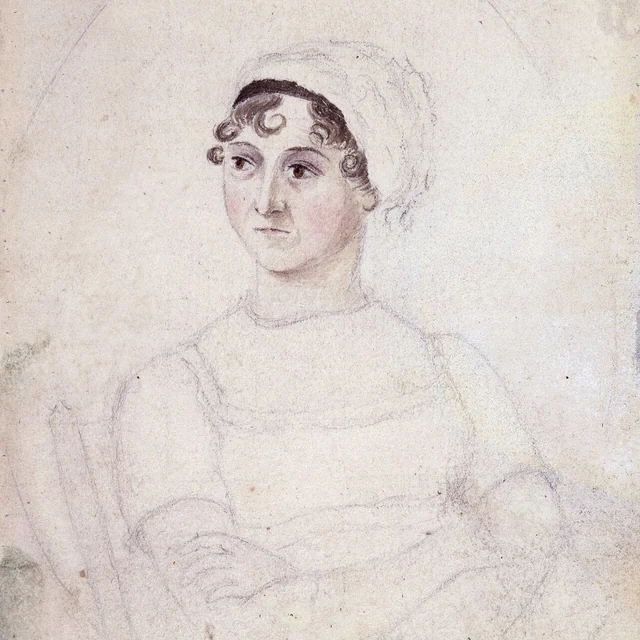
Jane Austen
Jane Austen (1775-1817) wrote six complete novels in a life spent almost entirely in Hampshire and Bath, in households where she had no room of her own and worked on a small writing table in the family sitting room. All four novels published in her lifetime appeared anonymously, credited only to "A Lady". She earned modest sums and no fame while alive; her brother Henry revealed her name after her death at forty-one. The reputation came later, and the irony that made her difficult for early readers is now the thing she is quoted for.
Photo: Cassandra Austen — Public domain, Wikimedia Commons
There is a trap in quoting Jane Austen. She writes in free indirect style, slipping in and out of her characters' heads, so a sentence can carry the voice of someone she is holding up for inspection. Pull it out of the paragraph and it reads as her considered view. Several of her most repeated lines are spoken by snobs, bores and liars, and the joke is lost the moment the speaker is dropped.
The opening everyone misreads
It is a truth universally acknowledged, that a single man in possession of a good fortune, must be in want of a wife. — *Pride and Prejudice*, narrator, first line
It is quoted as a statement of fact about the marriage market. The next sentence dismantles it: the truth is so well fixed in the minds of the surrounding families that the man is considered the rightful property of one or other of their daughters. Austen is describing what the neighbours assume, not what is true, and the whole novel argues with the sentence.
Elizabeth Bennet, who is usually right
I could easily forgive his pride, if he had not mortified mine. — *Pride and Prejudice*, Elizabeth
There is a stubbornness about me that never can bear to be frightened at the will of others. — *Pride and Prejudice*, Elizabeth
Till this moment I never knew myself. — *Pride and Prejudice*, Elizabeth, reading Darcy's letter
I dearly love a laugh. — *Pride and Prejudice*, Elizabeth
Darcy, in and out of his depth
In vain I have struggled. It will not do. My feelings will not be repressed. — *Pride and Prejudice*, Darcy, first proposal
You must allow me to tell you how ardently I admire and love you. — *Pride and Prejudice*, Darcy
I have been a selfish being all my life, in practice, though not in principle. — *Pride and Prejudice*, Darcy
My good opinion once lost, is lost forever. — *Pride and Prejudice*, Darcy
The characters being laughed at
I declare after all there is no enjoyment like reading! — *Pride and Prejudice*, Caroline Bingley, who is not reading, but watching Darcy read
Vanity and pride are different things, though the words are often used synonymously. — *Pride and Prejudice*, Mary Bennet, delivering a lecture nobody asked for
Nobody can tell what I suffer! — *Pride and Prejudice*, Mrs Bennet
You have delighted us long enough. — *Pride and Prejudice*, Mr Bennet, stopping his daughter's singing
For what do we live, but to make sport for our neighbours, and laugh at them in our turn? — *Pride and Prejudice*, Mr Bennet
Persuasion, written last and quoted most seriously
You pierce my soul. I am half agony, half hope. — *Persuasion*, Wentworth's letter
I can listen no longer in silence. I must speak to you by such means as are within my reach. — *Persuasion*, Wentworth's letter
All the privilege I claim for my own sex is that of loving longest, when existence or when hope is gone. — *Persuasion*, Anne Elliot
Men have had every advantage of us in telling their own story. The pen has been in their hands. — *Persuasion*, Anne Elliot
Emma, who is wrong about almost everything
I always deserve the best treatment because I never put up with any other. — *Emma*, Emma Woodhouse
If I loved you less, I might be able to talk about it more. — *Emma*, Mr Knightley
Badly done, indeed! — *Emma*, Mr Knightley, after Box Hill
Seldom, very seldom, does complete truth belong to any human disclosure. — *Emma*, narrator
One half of the world cannot understand the pleasures of the other. — *Emma*
Sense and Sensibility, Northanger Abbey, Mansfield Park
It is not everyone who has your passion for dead leaves. — *Sense and Sensibility*, Elinor to Marianne
I will be calm. I will be mistress of myself. — *Sense and Sensibility*, Marianne
The person, be it gentleman or lady, who has not pleasure in a good novel, must be intolerably stupid. — *Northanger Abbey*, narrator
Man has the advantage of choice, woman only the power of refusal. — *Northanger Abbey*, Henry Tilney
We have all a better guide in ourselves, if we would attend to it, than any other person can be. — *Mansfield Park*, Fanny Price
Let other pens dwell on guilt and misery. — *Mansfield Park*, narrator, refusing to write the unhappy ending
From the letters to her sister
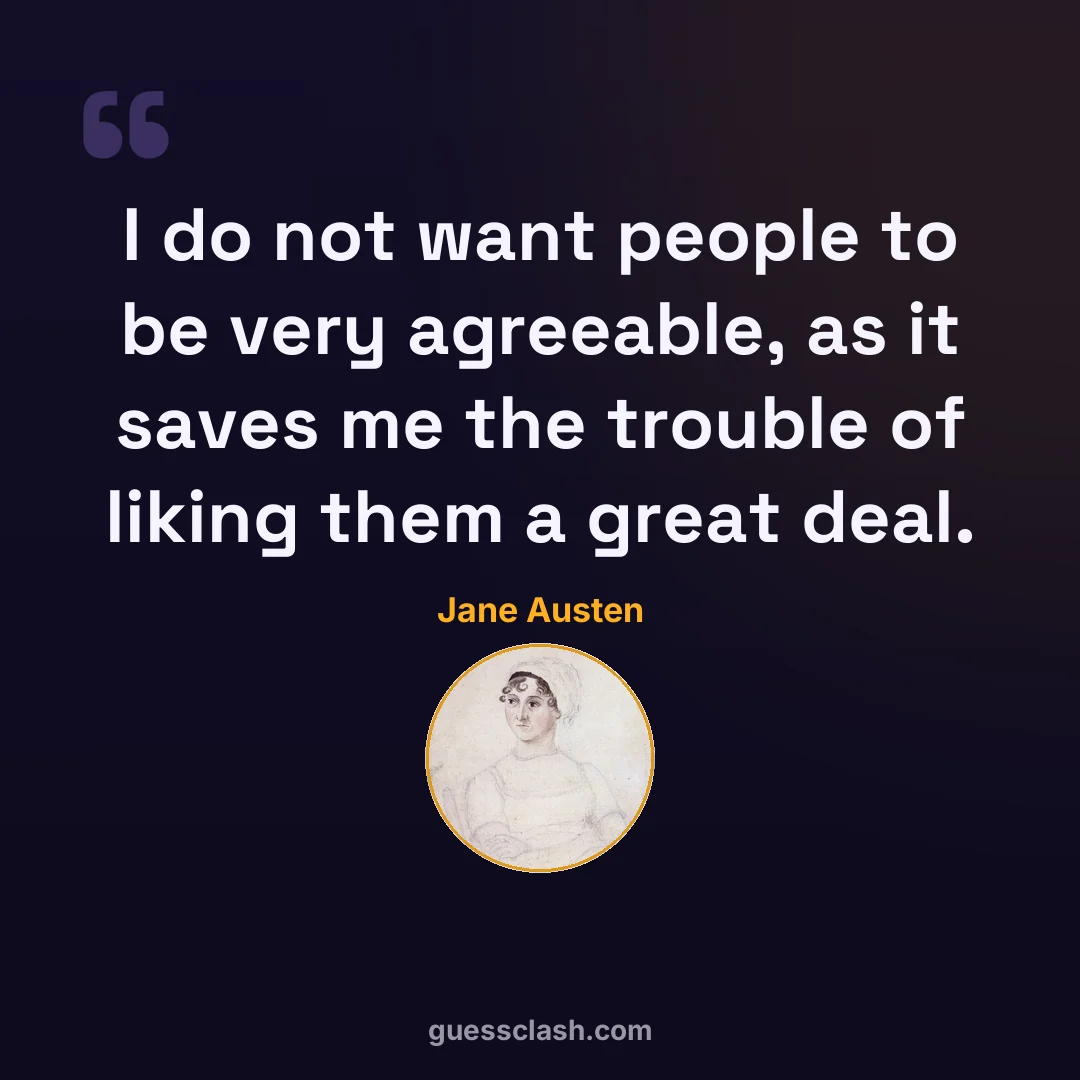
I do not want people to be very agreeable, as it saves me the trouble of liking them a great deal. — letter to Cassandra Austen, 1798
Wisdom is better than wit, and in the long run will certainly have the laugh on her side. — letter to Fanny Knight, 1814
Three things she is quoted as saying that need a footnote
- "Badly done, Emma! Badly done!" The novel has Knightley say *Badly done, indeed!* The version with her name in it comes from screen adaptations and is now quoted far more often than the text.
- "It is a truth universally acknowledged…" Quoted as Austen's own opinion in wedding speeches and property listings. In the book it is the assumption of gossiping neighbours, and it is undercut in the very next sentence.
- "I declare after all there is no enjoyment like reading!" Printed on bookshop tote bags as a reader's creed. Caroline Bingley says it while pretending to read a book she chose only because it was the second volume of Darcy's.
None of this makes the lines less usable. It makes them sharper. Austen's method is to let a character condemn themselves in a sentence that sounds perfectly pleasant, and the reader who knows who is speaking gets a second joke the quotation alone cannot deliver.
What is Jane Austen's most famous quote?
The first sentence of Pride and Prejudice. It is also the most frequently misused, because it is an ironic report of what the neighbourhood believes rather than a statement Austen endorses.
Did Jane Austen publish under her own name?
No. The four novels published in her lifetime appeared anonymously, the first as "By a Lady" and the rest as by the author of the previous one. Her name was made public by her brother after she died.
Is "Badly done, Emma" in the novel?
No. Mr Knightley says "Badly done, indeed!" The shorter version with her name is a screen invention that has largely replaced the original in quotation.
Sources
Keep reading
 Quotes & Sayings30 Nietzsche Quotes, and What "God Is Dead" Actually SaysThe most famous sentence in modern philosophy is usually read as a boast. In context it is spoken by a madman and it is a warning. Thirty quotes with the book and section number.
 Quotes & SayingsVan Gogh Wrote 800 Letters. Here Are 30 Lines From Them.Van Gogh sold almost nothing and explained almost everything, in letters mostly to his brother Theo. Thirty lines from the correspondence, plus four famous ones that appear nowhere in it.
 Quotes & SayingsDarwin's Most Quoted Sentence Is Not His: 30 That AreThe line about the species most adaptable to change was written by a business professor in 1963. Thirty quotes that really are Darwin's, from the books, the notebooks and the letters.
 Quotes & Sayings30 Emily Dickinson Lines, With the Dashes Put BackDickinson published about ten poems in her lifetime and her editors removed her dashes, added titles and smoothed her rhymes. Thirty lines in the punctuation she actually used.