Frederick Douglass in 30 Quotes: Struggle, Reading, and the Right to Say It
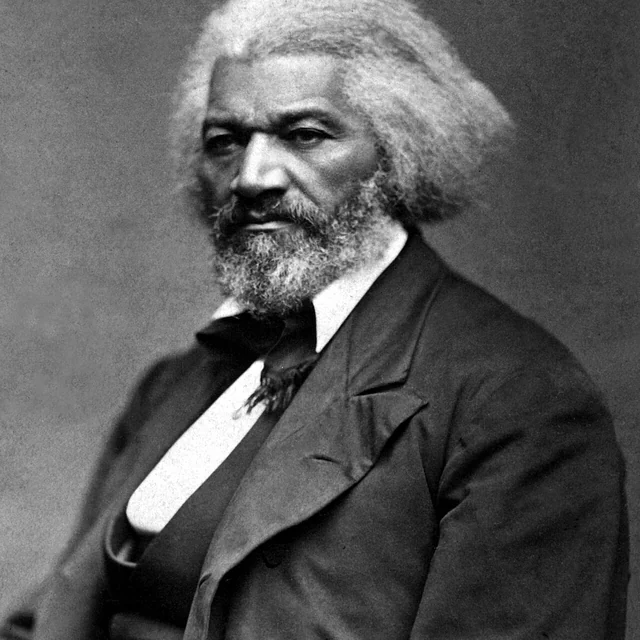
Frederick Douglass
Frederick Douglass was born into slavery in Maryland around 1818 and never knew his exact birthday. He learned the alphabet from his enslaver's wife until she was forbidden to continue, then traded bread to white children for reading lessons in the street. He escaped north in 1838 disguised as a sailor, became the most photographed American of the nineteenth century, published three autobiographies and the newspaper The North Star, advised Abraham Lincoln, and campaigned for women's suffrage. He died in 1895, hours after speaking at a women's rights meeting.
Photo: George Kendall Warren — Public domain, Wikimedia Commons
Frederick Douglass wrote and spoke for more than fifty years, and the range is easy to miss. He was an escaped slave, a newspaper editor, a diplomat, a suffragist and, above all, a professional arguer who understood that an argument is only useful if the person who disagrees has to hear it.
The lines below come from his speeches and his three autobiographies. Several are quoted constantly with the second half removed, which usually blunts the point.
On power and struggle
Power concedes nothing without a demand. It never did and it never will. — West India Emancipation speech, 1857
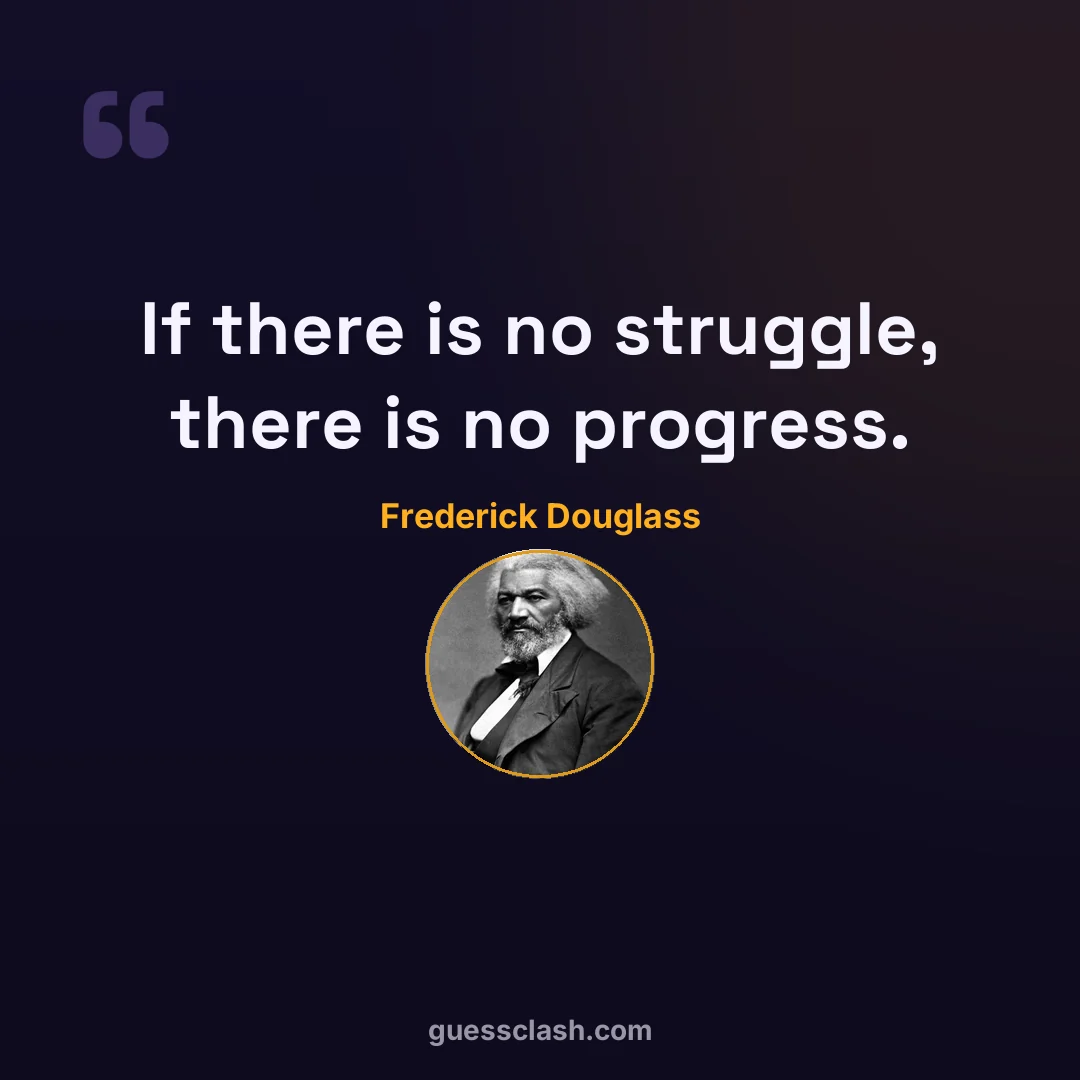
If there is no struggle, there is no progress. Those who profess to favour freedom, and yet depreciate agitation, are men who want crops without ploughing up the ground. — West India Emancipation, 1857
They want the ocean without the awful roar of its many waters. — same speech
Find out just what any people will quietly submit to and you have found out the exact measure of injustice and wrong which will be imposed upon them. — West India Emancipation, 1857
The limits of tyrants are prescribed by the endurance of those whom they oppress. — West India Emancipation, 1857
On reading and what it costs
Once you learn to read, you will be forever free.
Knowledge makes a man unfit to be a slave. — *Narrative of the Life of Frederick Douglass*, 1845
Education means emancipation. It means light and liberty. It means the uplifting of the soul of man into the glorious light of truth.
In learning to read, I owe almost as much to the bitter opposition of my master as to the kindly aid of my mistress. — *Narrative*, 1845
It was a new and special revelation, explaining dark and mysterious things, with which my youthful understanding had struggled in vain. — *Narrative*, on learning what abolition meant
On freedom
No man can put a chain about the ankle of his fellow man without at last finding the other end fastened about his own neck. — speech, 1883
I prayed for twenty years but received no answer until I prayed with my legs.
You have seen how a man was made a slave; you shall see how a slave was made a man. — *Narrative*, 1845
The soul that is within me no man can degrade.
I would unite with anybody to do right and with nobody to do wrong. — speech, 1855
On America, said to America
What, to the American slave, is your Fourth of July? I answer: a day that reveals to him, more than all other days in the year, the gross injustice and cruelty to which he is the constant victim. — What to the Slave Is the Fourth of July?, 1852
Your celebration is a sham; your boasted liberty, an unholy licence. — same speech, 1852
I have no love for America, as such; I have no patriotism. I have no country. — speech in Ireland, 1846
The life of the nation is secure only while the nation is honest, truthful and virtuous. — Our Composite Nationality, 1869
A man's rights rest in three boxes: the ballot box, the jury box and the cartridge box. — speech, 1867
On character and work
I would rather be true to myself, even at the hazard of incurring the ridicule of others, than false, and incur my own abhorrence.
Without a struggle, there can be no progress.
It is easier to build strong children than to repair broken men.
Where justice is denied, where poverty is enforced, where ignorance prevails, and where any one class is made to feel that society is an organised conspiracy to oppress, rob and degrade them, neither persons nor property will be safe. — speech, 1886
Truth is proper and beautiful at all times and in all places. — speech, 1852
On hope, which he refused to make easy
I will not argue that man has a right to liberty; that he is the rightful owner of his own body. To do so would be to make myself ridiculous. — Fourth of July speech, 1852
The whole history of the progress of human liberty shows that all concessions yet made to her august claims have been born of earnest struggle. — 1857
One and God make a majority.
We have to do with the past only as we can make it useful to the present and the future. — speech, 1884
If I have advice to give, it is this: agitate, agitate, agitate.
The line everyone shortens
"If there is no struggle, there is no progress" is printed on posters everywhere. The sentences that follow it are the ones that sting, and they are almost always cut: *those who profess to favour freedom, and yet depreciate agitation, are men who want crops without ploughing up the ground; they want rain without thunder and lightning.*
Douglass was not describing his enemies there. He was describing his allies, the people who agreed with him in principle and wished he would be quieter about it.
What is Frederick Douglass's most famous speech?
What to the Slave Is the Fourth of July?, delivered in Rochester, New York on 5 July 1852. He was invited to celebrate American independence and instead asked his audience what independence meant to the people still enslaved by it.
Did Frederick Douglass write his own autobiography?
He wrote three: Narrative of the Life of Frederick Douglass (1845), My Bondage and My Freedom (1855) and Life and Times of Frederick Douglass (1881). The first was written partly to prove that an escaped slave could in fact write it.
Why was he the most photographed American of his century?
By choice. Douglass sat for at least one hundred and sixty separate portraits and argued that photography let Black Americans control their own image at a time when illustration and caricature did not.
Sources
Keep reading
 Quotes & Sayings30 Nietzsche Quotes, and What "God Is Dead" Actually SaysThe most famous sentence in modern philosophy is usually read as a boast. In context it is spoken by a madman and it is a warning. Thirty quotes with the book and section number.
 Quotes & SayingsVan Gogh Wrote 800 Letters. Here Are 30 Lines From Them.Van Gogh sold almost nothing and explained almost everything, in letters mostly to his brother Theo. Thirty lines from the correspondence, plus four famous ones that appear nowhere in it.
 Quotes & SayingsDarwin's Most Quoted Sentence Is Not His: 30 That AreThe line about the species most adaptable to change was written by a business professor in 1963. Thirty quotes that really are Darwin's, from the books, the notebooks and the letters.
 Quotes & Sayings30 Emily Dickinson Lines, With the Dashes Put BackDickinson published about ten poems in her lifetime and her editors removed her dashes, added titles and smoothed her rhymes. Thirty lines in the punctuation she actually used.